Mr. Svidrigailov
Crime and PunishmentMr. Svidrigailov emerges through others’ accounts as a married landowner whose pursuit of Avdotya Romanovna Raskolnikova turns her employment in his household into a crisis. His conduct first appears as rudeness and mockery, then becomes an explicit proposal; later, the letter she wrote refusing him becomes the proof that clears her name. The account does not give him a direct scene or access to his thoughts, so his motives remain partly conjectural, while the consequences of his actions are described in detail.
Position in the Household
Avdotya Romanovna Raskolnikova had taken a governess position in the Svidrigailov household and received a hundred roubles in advance. Because part of her salary was to be deducted each month, leaving immediately would have meant repaying the debt. Her mother’s account also explains that Avdotya had taken the position chiefly to send sixty roubles to her brother, Rodion Romanovitch Raskolnikov, whose need was acute. The arrangement therefore made her both financially constrained and responsible for helping her family.
Mr. Svidrigailov was Marfa Petrovna’s husband and the father and head of a family. According to the mother’s letter, he initially treated Avdotya Romanovna rudely and made disrespectful, jeering remarks at table. His behavior was especially difficult when he drank and, as the letter puts it, fell back into old regimental habits. The outward contempt concealed a different intention: the mother later understood his rudeness as a way of masking a passion for Avdotya Romanovna. She offers this as a possible explanation, not as knowledge of his private reasoning, suggesting that he may have been ashamed of his hopes or angry at himself for them.
Pursuit and Avdotya’s Refusal
The pursuit eventually became explicit. Mr. Svidrigailov made Avdotya Romanovna an open proposal, offering inducements and proposing that he abandon his existing life to take her to another estate or abroad. The proposal placed her in a perilous position within the household, but she could not simply resign: the advance-payment debt remained, and a sudden departure risked arousing Marfa Petrovna’s suspicions and precipitating a family rupture. The mother also feared the public scandal that would attach to Avdotya Romanovna.
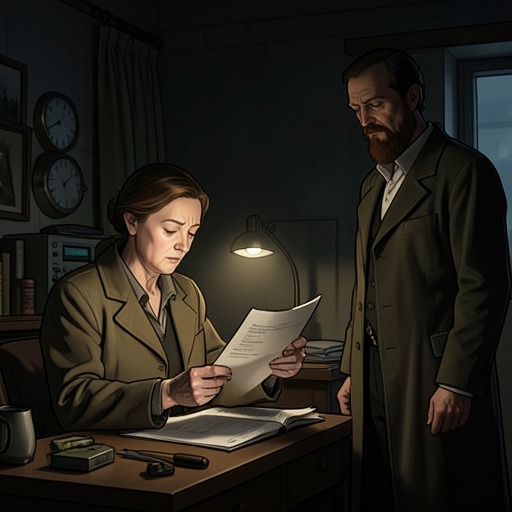
Avdotya Romanovna wrote to Mr. Svidrigailov before Marfa Petrovna found them together in the garden. In the letter, she refused personal explanations and secret meetings, reproached him for his conduct toward his wife, and reminded him that he was a family’s father and head. She also condemned his tormenting of a girl already made vulnerable by her circumstances. The letter thus records a refusal in Avdotya Romanovna’s own words and makes clear that the secret meetings were something he had been seeking, not something she had accepted.
Exposure and Reversal
Marfa Petrovna overheard Mr. Svidrigailov imploring Avdotya Romanovna in the garden but initially interpreted the scene against her. She blamed Avdotya Romanovna, struck her, refused to hear an explanation, and ordered her sent away in a plain peasant’s cart with her belongings thrown in untidily. In a heavy shower, Avdotya Romanovna was driven seventeen versts into town. For a month, the scandal spread through the town and surrounding district: acquaintances avoided the women, people whispered or made remarks aloud, and the family even faced the threat of being driven from its lodging after talk of an attempted public insult.
After Avdotya Romanovna’s departure, Mr. Svidrigailov retained her letter. When he returned to his senses and repented, he showed it to Marfa Petrovna as unmistakable proof of Avdotya Romanovna’s innocence. Servants’ evidence also helped clear her; they knew more about what had happened than he had supposed. Marfa Petrovna accepted the proof, sought forgiveness, and publicly corrected her earlier accusations, taking the letter around town and reading it to others. The same husband whose pursuit had triggered the scandal therefore supplied a crucial document that reversed its central accusation. The account does not describe a direct apology from him to Avdotya Romanovna; it reports his repentance and the use he made of the letter.
Narrative Significance
Mr. Svidrigailov is characterized here through a chain of consequences rather than through an independent portrait: his taunts, proposal, and pursuit produce Avdotya Romanovna’s confinement and public disgrace, while the letter he kept helps restore her reputation. The mother’s account is retrospective and protective of her daughter, and it explicitly presents some explanations of his behavior as possibilities. Its strongest evidence about Avdotya Romanovna’s response is the letter itself, as reported by the mother: she refused secret access and challenged him on moral and familial grounds.
Rodion Romanovitch Raskolnikov later recalls that his sister had endured Mr. Svidrigailov and the rest of the household’s treatment. He treats this ordeal as a bitter measure of what she had already borne, while rejecting the idea that she would readily surrender her moral freedom for comfort. His reflection connects Mr. Svidrigailov’s conduct to the later question of whether Avdotya Romanovna might sacrifice herself for her family, but it is Raskolnikov’s interpretation of her character, not further evidence about Mr. Svidrigailov’s motives. In this account, the man remains morally consequential even in absence: first the source of an injury, then the holder of the evidence that undoes its public consequences.